Understanding Roofing Safety Standards for Homeowners and Contractors
When you hire a roofing contractor, you are trusting them with something that sits right above your head. A roof protects your home from the elements, but the work required to install or repair one carries serious risks. Roofing safety standards exist to manage those risks. They are not just bureaucratic paperwork. They are the difference between a job done well and a preventable accident. I have worked in and around the trade long enough to see both sides, and I can tell you that the contractors who take safety seriously are the ones you want on your roof.
For homeowners in Bearsden and surrounding areas, understanding these standards can help you ask the right questions before work begins. It also helps you spot a professional who knows what they are doing. Let us look at what roofing safety standards mean in practice, and why they matter for every project from a simple gutter repair to a full roof replacement.
The Legal Framework Behind Roofing Safety
The Health and Safety Executive (HSE) sets the rules that govern construction work in the UK. For roofers, the most important regulation is the Working at Height Regulations 2005. This is not a suggestion. It is the law. It requires that any work at height is properly planned, supervised, and carried out with the right equipment. Falls from height remain the single biggest cause of fatal injuries in the construction industry. The HSE reports that falls from height accounted for a significant proportion of workplace deaths each year, and roof work is a major contributor.
RIDDOR (Reporting of Injuries, Diseases and Dangerous Occurrences Regulations) requires employers to report serious injuries and near misses. This data helps the HSE and industry bodies like TRAC (Tile Roofing Advisory Council) understand where the biggest risks lie. TRAC works with manufacturers and contractors to improve safety on pitched roofs. They publish guidance on everything from roof anchor points to tile cutting. If a roofer mentions TRAC guidance, that is a good sign they keep up with current best practice.
One specific standard you might hear about is BS 5531. This is the British Standard for scaffolding. It covers the design, erection, and use of scaffolding. When a contractor arranges scaffolding hire, they should ensure the scaffold is erected by competent people and inspected before use. BS 5531 sets the benchmark for that work. A roofer who insists on compliant scaffolding is not being fussy. They are being professional.
Practical Safety Measures on Site
So what does a safe roofing site look like in practice? Let me walk you through some of the key elements.
Edge Protection and Fall Prevention
The most obvious hazard on a roof is the edge. Without proper edge protection, a slip or a misstep can be fatal. Good edge protection might be a guardrail system fixed to the roof structure, or it could be a combination of scaffolding and safety netting. For lower roofs, a simple barrier may be enough. For steep pitches, you need something more robust.
Roof anchor points are another critical piece of the puzzle. These are fixed points on the roof structure where a worker can attach a safety harness. The harness is your last line of defence. If the edge protection fails or the worker moves beyond it, the harness stops the fall. Anchor points must be installed correctly and tested to the right load. A reputable roofer will have them fitted by a trained person and checked regularly.
Ladder safety is also a big part of the picture. Ladders get used for access all the time on roofing jobs, but they are also a common source of injury. A ladder should be the right height, placed on stable ground, and secured at the top and bottom. The HSE advises that ladders should only be used for low-risk, short-duration work. For anything more involved, scaffolding or a tower should be used instead. A roofer who leans a ladder against a gutter and climbs up without tying it off is not someone I would trust with my roof.
Personal Protective Equipment (PPE)
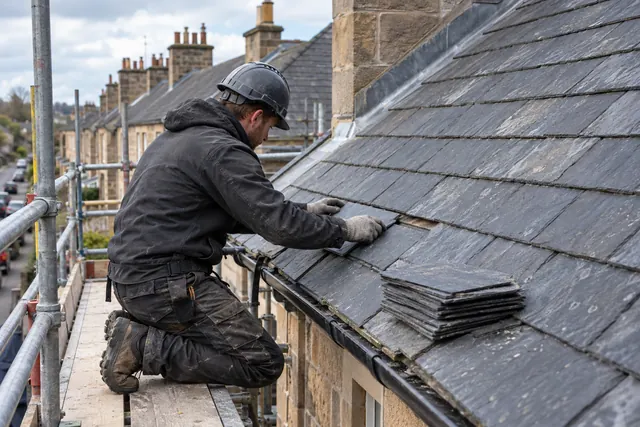
Personal protective equipment includes hard hats, gloves, safety boots, and eye protection. On a roofing site, you will also see safety harnesses and sometimes respirators if the work involves dust or fumes. Hard hats are not optional when there is any risk of something falling from above. Gloves protect hands from sharp edges and from chemicals used in some roofing materials. Safety boots with steel toe caps protect feet if a tile or a tool gets dropped.
Some contractors will provide PPE as part of their standard kit. Others expect workers to bring their own. Either way, it is the employer's responsibility to ensure the right PPE is available and that workers are trained to use it. If you see a roofer on a roof without a hard hat or a harness, that is a red flag.
Training and Competence
Safety equipment is only as good as the person using it. That is why training matters so much. CPD (Continuing Professional Development) is how experienced roofers stay current. They attend courses, read guidance from bodies like TRAC, and learn about new materials and methods. A roofer who invests in CPD is someone who takes their trade seriously.
Some training covers specific skills like working at height, ladder safety, or manual handling. Manual handling is the safe way to lift and carry heavy materials. Roofing involves a lot of heavy lifting: tiles, slates, rolls of felt, and bundles of timber. Poor manual handling leads to back injuries that can end a career. A good roofer knows how to lift with their legs, not their back, and how to use mechanical aids like hoists or conveyors to move materials up to the roof.
Site clearance is another area where training pays off. Before work starts, the site should be cleared of debris, tools, and anything that could cause a trip or a slip. After the work, the site should be left clean and safe. A cluttered site is an accident waiting to happen.
Insurance and Accountability
Roofing company insurance is not directly part of safety standards, but it is closely linked. A contractor with proper insurance shows they take their legal responsibilities seriously. Public liability insurance covers damage to your property or injury to a third party. Employer's liability insurance is a legal requirement if they employ staff. If a contractor cannot show you proof of insurance, that is a big warning sign.
The same goes for accreditation. Organisations like Roofing UK and TRAC offer certification schemes that signal a commitment to quality and safety. When you are looking for Bearsden roofers, ask whether they are registered with any of these bodies. It is not a guarantee, but it is a good indicator that they follow roofing safety standards.
What Homeowners Should Look For
If you are a homeowner planning a roofing project, here are some practical questions you can ask a prospective contractor:
- Do you follow the Working at Height Regulations on every job?
- What edge protection do you use on pitched roofs?
- Do you use roof anchor points and safety harnesses?
- Can you show me your insurance certificates?
- Are you a member of TRAC or Roofing UK?
These questions are reasonable. A professional roofer will be happy to answer them. If they get defensive or vague, that is a reason to look elsewhere.
The Cost of Ignoring Safety
I have seen jobs where a contractor cut corners on safety to save time or money. They skipped the scaffolding hire and worked off a ladder. They did not install edge protection because it took too long. They let workers carry heavy tiles up a ladder without any manual handling training. In every case, something went wrong. Sometimes it was a near miss. Sometimes it was an injury that put someone in hospital. And in the worst cases, it was a fatality.
The financial cost can also be huge. A serious accident can lead to an HSE investigation, a fine, and a criminal prosecution. The contractor might lose their insurance. The homeowner might be left with an incomplete roof and a legal battle. All of that is avoidable if the work is done to proper roofing safety standards from the start.
Roofing safety standards are not just for the contractor. They protect the homeowner too. When a roofer follows the standards, the job is more likely to be done correctly, on time, and without damage to your property. You get peace of mind. And that is worth paying for.
In the end, a good roofer is someone who treats safety as a core part of their work, not an afterthought. They plan for it, they equip for it, and they train for it. If you are looking for Bearsden roofers, look for someone who can show you that commitment. Your roof - and everyone under it - will be safer for it.